
What Caribou County Deeds Do
A deed conveys an interest in land. Other recorded instruments work differently. Mortgages, releases, and plats may burden, release, or map that interest, and Caribou County's published recording schedule confirms several such document families, though the full local category list is not posted online.
| Deed Type | What It Does | Common Use |
|---|---|---|
| Warranty or grant deed | Conveys the stated ownership interest with promises written in the instrument | Ordinary sale or transfer |
| Quitclaim deed | Transfers whatever interest the grantor has without promising that interest is good | Family transfer or correction |
| Executor or administrator deed | Conveys estate property through an authorized representative | Probate distribution or sale |
| Tax deed | Records a transfer tied to delinquent-tax proceedings | Tax-deed chain |
| Corrective deed | Corrects text in an earlier conveyance while referring back to it | Name or description correction |
Mortgages, deeds of trust, releases, reconveyances, easements, and liens are not deeds of ownership. They still belong in a full deed-record search. A plat or survey depicts the land itself. It may be cited by a deed. Read each item by its legal role, not its label.
Reach the Caribou County Recorder
The Caribou County Clerk and Recorder sits in Room 202 at 159 South Main. The office is in Soda Springs. Hours run Monday through Friday, 9 a.m. to 5 p.m. You can request deeds by email at recording@caribouid.gov. You can also use the counter, mail, or the phone at (208) 547-4324 extension 4. That direct route matters. The county posts no public grantor-grantee form or document-image viewer. No index start year is posted either. Ask staff where a cited item lives. It may sit in a bound book, on microfilm, or as a scan. Give names, land, and dates. The official Clerk page lists the local contact and recording route. A precise request saves everyone time.
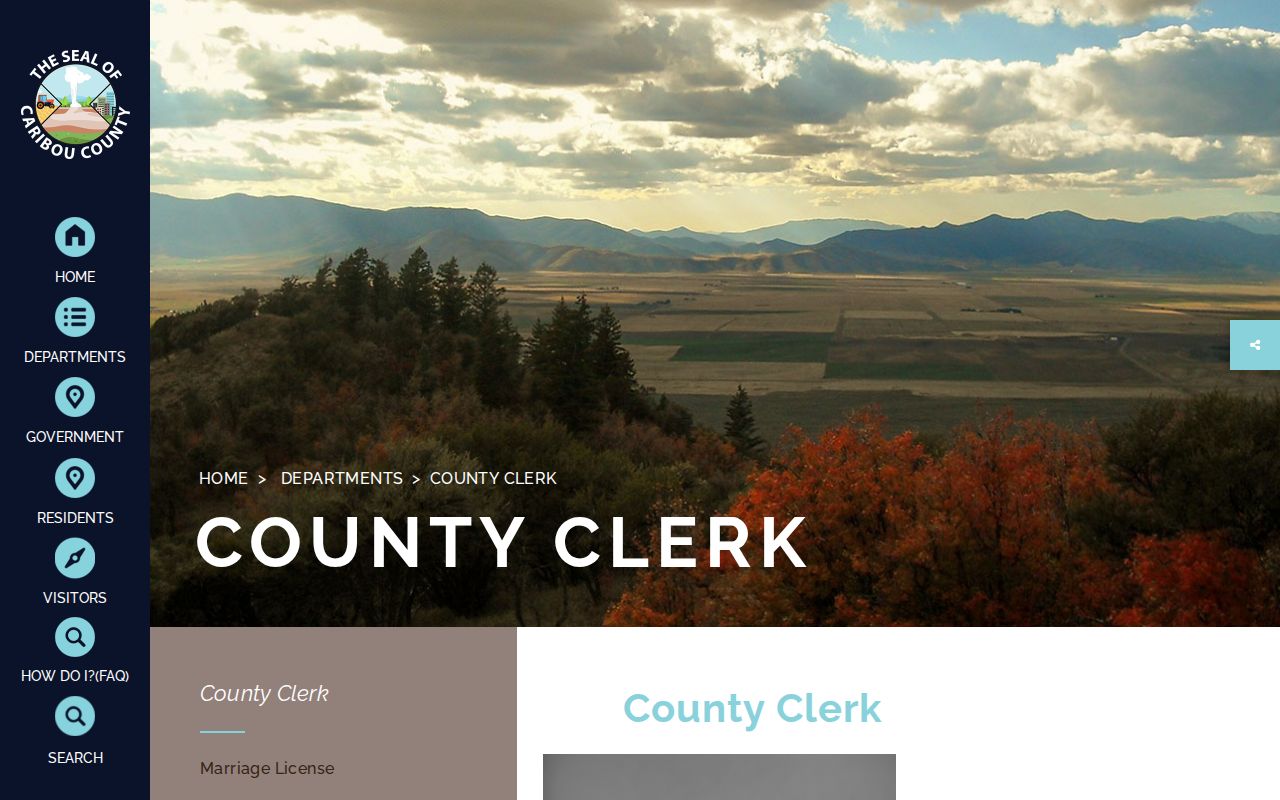
The Clerk's page shows the recording route plainly. Direct requests work best here. Note: The absence of a public web index does not mean the recorded deed or paper index is absent.
Follow Caribou County Grantor-Grantee Entries
Idaho Code §31-2413 directs indexing by the person executing an instrument and the person receiving it, which lets a searcher run backward or forward through Caribou County deed records. The grantor transfers; the grantee receives. That pair powers a grantor-grantee search.
- Locate the current conveyance with the present owner as grantee, using the parcel PIN and legal description to confirm the match.
- Read the grantor, recording date, deed type, and document reference from that instrument.
- Search the grantor as a grantee in an earlier period to locate how that party acquired the land.
- Repeat while checking every legal description, exception, split, merger, and cited prior instrument.
- If the chain crosses 1919, ask about the predecessor Bannock County records.
- Grantor
- The party who executes or transfers the interest.
- Grantee
- The party who receives the stated interest.
- Chain of title
- The linked sequence of recorded transfers affecting the same land.
- Book and page
- An older volume citation for a recorded paper.
- Instrument number
- A unique modern recording reference when assigned.
Frame a Caribou County Deed Search
There is no public portal. A written request takes its place. State your goal, then supply the exact details already found in GIS, a tax record, or another deed, since the Clerk searches most efficiently when names are paired with land and a time frame.
| Request Item | Format | Why It Helps |
|---|---|---|
| Grantor and grantee | Full names plus variants | Matches both index sides |
| Recording period | Narrow start and end dates | Reduces name collisions |
| Document type | Deed, release, easement, plat, or other class | Targets the right instrument |
| PIN and situs | Exact map values | Connects the request to one parcel |
| Legal description | Lot/block or rural calls | Confirms land identity |
| Document reference | Instrument number or book/page | Pulls a known item |
| Copy details | Plain or certified, count, delivery | Lets staff quote and fill the order |
Use an entity's exact legal spelling. Include its earlier names too. Estates may appear under “Estate of” with the personal representative, trusts may be indexed by trustee, trust name, or an abbreviated form, and same-name individuals require a PIN, date, and legal-description match to tell them apart.
Budget Caribou County Deed Copies
Copies of requested recorded documents cost $1 per page in Caribou County. Recording fees are separate. The posted schedule, effective July 1, 2017, sets $15 for a deed, grant, or conveyance up to 30 pages, with $3 for each extra page. A deed of trust or mortgage group costs $45. Substitutions, reconveyances, and mortgage releases run $15 each. Powers of attorney are $25.
Surveys and plats cost $5 per page. Corner perpetuations are $10. Other recordings run $10 for the first page plus $3 for each extra page. These figures are filing prices, not proof of a current certification charge, so ask the Clerk to confirm the copy total, certification cost, accepted payment, and delivery, and include a self-addressed stamped envelope for returned documents.
Cross Into Bannock County Deeds
Caribou County was formed from Bannock County on February 11, 1919. Land chains cross that line. The parcel stays put. Only the county name changes. The oldest relevant instrument may therefore live in Bannock County, or in an earlier territorial record system, depending on its date and location.
Start with a current Caribou deed that recites an older instrument, copying its date, parties, legal description, and book or page reference. Then extend the request into the predecessor county. The Idaho State Archives reports county land, property, tax, court, map, newspaper, and government holdings dating from 1863 generally. Confirm exact runs item by item.
Note: County formation is a catalog clue, not a break in the land's recorded history.
Connect Caribou County Plats
A deed may cite a subdivision, lot, block, survey, easement, or right-of-way. It can do all of this without drawing any of it. Request the cited plat or survey alongside the deed. For rural acreage, keep the section, township, range, aliquot parts, and every metes-and-bounds call. A GIS map can orient the words. It cannot replace them.
Releases and reconveyances also need links back to the original mortgage or deed of trust. Match the parties, beneficiary or lender, parcel description, and reference number. A paid debt is not a recorded release. A shared road or fence in GIS does not prove an easement.
Obtain a Caribou County Deed
Request the exact instrument rather than just a deed. Give the Recorder the parties, document type, recording range, PIN, legal description, and any citation you already have. Decide early whether a plain copy suits your research. A certified copy may be needed for official use. Staff can also walk you through retrieval options for older volumes in the Caribou County deed records. Mailing is another option.
Idaho Code §55-811 gives a properly recorded conveyance constructive-notice effect against later purchasers and mortgagees. That is why recording dates carry weight in a chain of title. Still, an index line proves nothing by itself. Read the full granting clause and the stated capacities. Check the exceptions and the acknowledgments too. Review the legal description before relying on the instrument.
Recorded does not mean guaranteed. Caribou County deed records show accepted instruments, not a title opinion. Unrecorded rights, defects, or later papers may still affect the land.
Check the returned copy line by line against your request. Confirm the county, recording stamp, date, parties, capacity, notary acknowledgment, and legal description. Attachments count too. If the description incorporates a plat or an earlier deed, pull that source as well. A page count that skips an exhibit can hide the very part that identifies the land. For certified use, keep the certification attached. Do not treat a downloaded scan of uncertain origin as a substitute.
Repair a Caribou County Deed Chain
A clean Caribou County chain can break in familiar ways. Names, parcels, and legal descriptions shift over time. A trust may appear under the trustee in one instrument and under the trust name in another. A company may show an earlier legal name. An estate transfer may move through probate before an executor or administrator deed is recorded. A life estate can name one person in the granting language while another holds the remainder. Search every capacity and read the deed text rather than assuming each named party owned the land.
The land itself causes a second kind of break. A parent tract may be divided into lots or smaller metes-and-bounds parcels. Later parcels may be merged back together. Follow the legal-description recital and every cited plat, survey, or prior instrument. Keep both the old and new PINs if staff can identify them. A tax identifier can change at any point. The recorded description is the bridge that carries the chain across the gap. Pair any corrective deed with the paper it corrects. The newer document may revise only a single clause.
Liens and releases need their own parallel chain. Match each mortgage or deed of trust to later assignments, substitutions, reconveyances, releases, or satisfactions. A bare claim that a loan was paid proves nothing. Only a recorded release clears the lien. Court judgments, quiet-title orders, probate distributions, and tax-deed proceedings can also explain a gap. A grantor-grantee sequence may look incomplete for these reasons. Search iCourt for general case information first. A docket may point to land rights. Request the actual case file from the clerk of the filing county.
The Grace-area report offers a useful warning. It mixes a 1922 description, a 1932 Bannock deed, and a 1942 tax deed in one chain. Shifting county jurisdiction, historic text, and tax-title history all combine there. Retrieve each cited instrument before drawing a conclusion. Pull any later correction, survey, boundary agreement, or court order too. A newspaper report can locate the puzzle. Only the underlying records in the Caribou County property records can document how the chain actually resolves.