
Fields in Caribou County Tax Records
A complete Caribou County property tax check draws on both offices. The public Assessor page links the parcel map and exemption resources. The Treasurer publishes bill, payment, and calendar details. Some parcel-card fields do not appear in public page text, so request a dated record rather than assuming a value is visible online.
| Field | What It Shows | Where to Confirm |
|---|---|---|
| PIN | The parcel key used to match land | GIS and Assessor |
| Market or assessed value | The county's annual estimate for tax administration | Assessor |
| Exemption | An approved reduction under the relevant program | Assessor |
| Taxable value | The value left after applicable reductions | Assessment and tax roll |
| Tax bill number | The five-digit key used by the payment page | Treasurer bill |
| Amount and status | Current charge, installments, payment, or delinquency | Treasurer |
Caribou County publishes no searchable tax roll online. Field labels also vary from office to office. Ask the assessor or treasurer for the tax year, parcel PIN, record date, and field definitions so you can compare figures correctly.
Find a Caribou County Tax Bill
Start with the Caribou County Assessor and its parcel-viewer link. Confirm the parcel before any payment tool is opened. The Point & Pay system is not a general owner or address search, and it requires bill details already supplied by the county.
- Locate the parcel by address in the county map, then copy the displayed PIN.
- Ask the Assessor to confirm the assessment year, value, classification, and exemption.
- Get the five-digit property tax bill number and amount due from the Treasurer or tax notice.
- Enter those values at Point & Pay and review the parcel and amount before approving payment.
- Save the dated receipt and ask about any balance or prior payment that is unclear.
The Caribou County Point & Pay page asks for a bill number and the amount due, then moves through review, agreement, processing, and a receipt. Treat it as a payment channel, not title evidence.
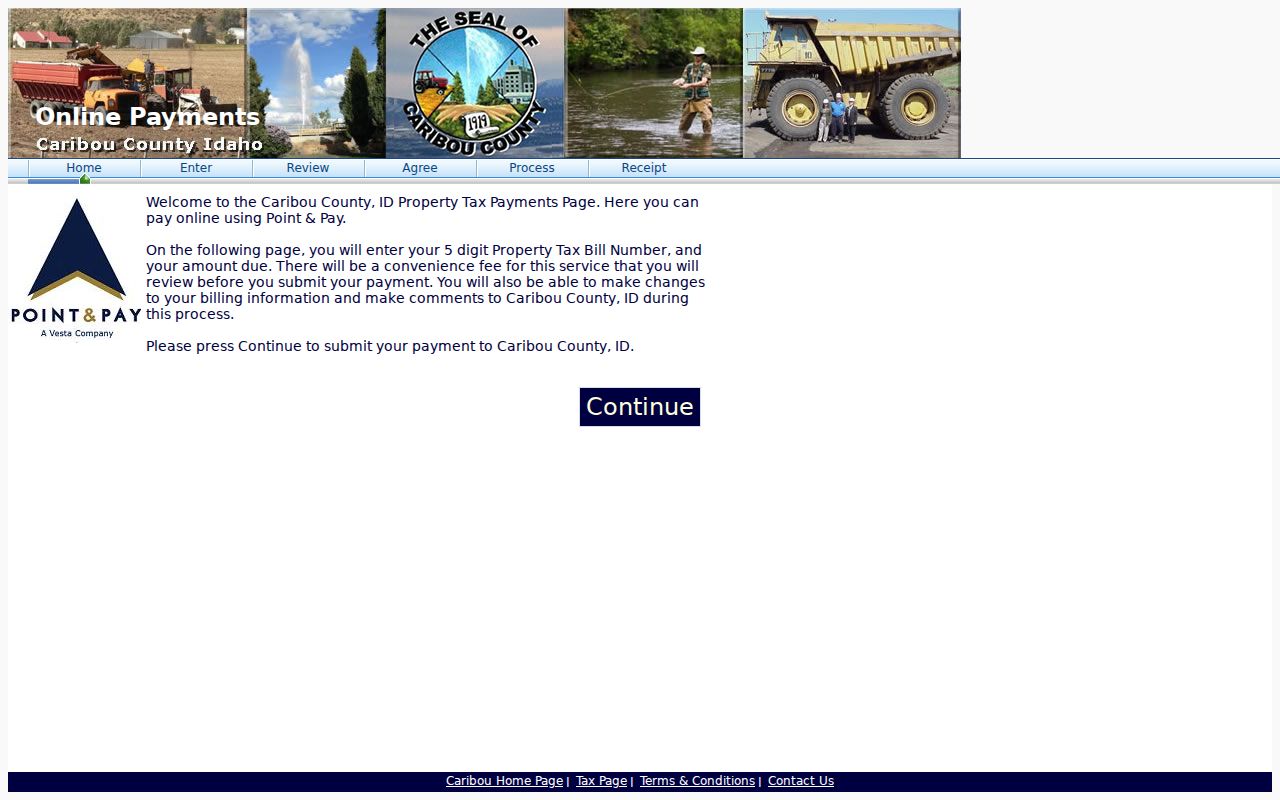
The payment screen displays bill-number and amount-due fields. Get the bill number first and match it to the intended parcel before sending funds.
Define Caribou County Tax Values
Caribou County tax paperwork repeats a few near-identical terms. Knowing the difference between a value, an assessment, and a bill makes any property records comparison easier.
- Market value
- The Assessor's estimate of what a typical buyer would pay as of January 1.
- Assessed value
- The value entered for county tax administration under Idaho's annual market-value framework.
- Taxable value
- The value remaining after applicable exemptions.
- Levy
- The rate produced by district budgets and the taxable base.
- Tax lien
- A legal claim tied to unpaid tax that must be confirmed in official records.
An assessment is an annual estimate of value. The assessor's model weighs sales price, size, and location. It also weighs construction quality, age, and condition. A sale price records just one event in time. The final tax bill then shifts with exemptions and levies on top of that value. Note: Idaho's market-value standard does not promise that one sale price and one assessment will match.
Track Caribou County Tax Dates
The Caribou County Treasurer publishes the local tax calendar each year. December 20 is the deadline to pay without penalty. Pay the full tax or the first half by that date. Miss it and late charges plus interest begin. June 20 closes the second half, with interest figured from January 1. Other dates matter just as much. January 1 opens the Circuit Breaker application window. April 15 is the posted last day to apply. The fourth Monday in June is the assessment-value appeal deadline. Confirm your current-year notice with the office before acting. For payment details and calendar specifics, the official Treasurer page is the dated source.

Deadlines and payment instructions live with the collecting office, not the Assessor, which handles valuation for Caribou County property records.
Pay Caribou County Property Tax
Paying Caribou County property tax online is convenient but not free of small charges. The Treasurer applies a $1.50 fee to e-checks. Debit and credit card payments cost 2.5 percent. Enter the bill number and amount with care. Before you submit, compare the confirmation details against the parcel number and the tax year you intended.
Mail, counter, installment, prior-year, and correction questions all go to Room 204 at 159 South Main in Soda Springs. The phone number is (208) 547-3726, and email reaches the office at treasurer@caribouid.gov. Counter help is available Monday through Friday, 9 a.m. to 5 p.m. Whenever you need proof of standing, ask for a dated status statement in writing.
Note: A payment receipt shows a transaction cleared, not that every tax issue on the parcel is settled.
Review Caribou County Tax Relief
Caribou County property tax relief comes in several forms. The Assessor publishes guides for each. Offerings include a homeowner guide and manufactured-home material. There is also personal-property valuation information and a casualty-loss exemption. Agricultural exemption applications cover tracts of five acres or less. A separate form exists for larger tracts. The homeowner exemption rounds out the list. Eligibility rules and required forms vary. Never carry an old exemption label forward without confirming it still fits.
Ask the office which application applies. Ask what evidence to bring, the filing date, and the effective year. Ask how the reduction will appear on the tax roll. Circuit Breaker relief runs on its own schedule. Its posted application window runs from January 1 through April 15. For valuation questions, the Assessor value page is the county's route.
The Assessor's office page is an entry point rather than a sample parcel card. Any parcel-specific figures still need direct confirmation from the office itself.
Contest a Caribou County Assessment
A Caribou County property tax appeal starts with the Assessor or the assigned appraiser. Sit down with the parcel description. Check the land and improvement facts. Review the class, the condition, and the data behind the market value estimate. If the disagreement survives that conversation, file through the County Clerk for the Board of Equalization. The board generally hears appeals from the fourth Monday in June through the second Monday in July.
Strong evidence makes the difference. A corrected legal description can support your case. Dated photographs, recent arm's-length sales, repair facts, or proof of a classification error can help too. Idaho ratio studies test whether assessments countywide are level and uniform. Yet a countywide ratio never settles the value of one parcel. A further appeal can go to the State Board of Tax Appeals. Or it can go to district court within the applicable period.
File on time. Caribou County posts the fourth Monday in June as the assessment-value appeal deadline. Confirm the current year and forms before relying on that date.
Verify Caribou County Tax-Deed Status
The Treasurer can link a tax bill to tax-deed information. But Caribou County publishes no online delinquent-property or auction search. A request has to go through the office itself. Ask for the parcel's PIN, the tax years owed, and the balance. Also ask for the notice date, the redemption stage, and any tax-deed event. Then take the outcome to the Recorder. Ask there for the resulting recorded notice or deed.
One caution comes from local news coverage. A July 2025 report described a Caribou County parcel with roughly $21,000 in back taxes. It also mentioned a possible January auction. A story like that is a lead, not a legal status. Only official accounts, redemption facts, and recorded papers establish what occurred. Never call a parcel sold on the strength of a meeting report.
Note: Tax delinquency, a pending tax deed, and a completed recorded transfer are three different stages.
Build a dated timeline for any distressed parcel. Log each tax year, every notice, and the stated redemption period. Include any tax-deed recording, sale, or later conveyance. Record the purchaser too. Mark newspaper items as reported and county documents as verified. The habit keeps a possible future event from hardening into a completed transfer. It also keeps the tax record distinct from the deed that finally changes title.
Request Caribou County Tax Evidence
When the Caribou County property tax records online route leaves a question open, split the request by custodian. The Assessor owns the valuation side. Ask that office for the parcel PIN, the assessment year, land and improvement values if they are maintained, the total assessed or market value, the property class, any exemption code or amount, and the situs address. Note the date the owner field was last refreshed. The Treasurer owns the billing side. Request the five-digit bill number, the tax year, the original charge, installments, payments, balance, late charges, interest, the delinquency stage, and any tax-deed notices. Neither office can certify the other's record.
A strong request names the parcel precisely. An owner's name alone is not enough. Give the PIN, the situs address, a fragment of the legal description, and the tax year. Say which format you need. Electronic, plain paper, and certified copies each serve a different purpose, and the Idaho Public Records Act asks that a request be specific about terms, dates, and format. State guidance sets free-processing thresholds for Idaho residents. Parcel-specific county fees and certification charges still need confirming with the local custodian.
Keep a response date beside every number. Idaho assesses taxable property at current market value each year, with January 1 as the valuation date under state guidance. A later payment, exemption decision, correction, Board of Equalization action, or recorded transfer can make an earlier figure incomplete. When two records disagree, check the basics. Ask whether they refer to different tax years, assessment dates, bill stages, owners, or parcel versions.
Taxing districts deserve attention too. City, school, county, and other levies follow the parcel's location. A Soda Springs postal address proves little. It does not put a parcel inside the city. The ZIP reaches into surrounding territory, and the county map carries an Area of Impact layer, so check jurisdiction boundaries before reading a district label. For a sale review, give assessment, taxable value, bill amount, and sale consideration separate columns. The assessment reflects the county's annual model, the taxable value reflects allowed reductions, and the bill applies the levies. A recorded price reflects a transaction. It may require reading the deed. No single figure is a market appraisal or a title determination; their value comes from being sourced, dated, and compared on equal terms.